
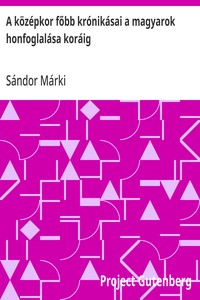
A középkor főbb krónikásai a magyarok honfoglalása koráig by Sándor Márki
Let's be clear: this isn't a novel. You won't find a traditional plot with heroes and villains. Instead, the "story" here is the story of history-writing itself. Sándor Márki, a Hungarian historian from the late 19th century, acts as your curator for a gallery of medieval chroniclers.
The Story
Márki systematically introduces us to the major historical writers who covered the early Hungarians, from their legendary origins up to their conquest of the Carpathian Basin (around 895 AD). Think of figures like the anonymous author of the Gesta Hungarorum or Simon of Kéza. Márki presents each one: who they were (when we know), when they wrote, and, most importantly, what their agenda might have been. The book shows how these writers weren't just recording events—they were often crafting a useful past for their royal patrons, blending fact, legend, and outright invention. The narrative is Márki piecing together this puzzle, showing where these accounts agree, where they wildly disagree, and what that tells us about both the past and the people writing about it.
Why You Should Read It
This book completely changed how I think about history. It pulls back the curtain. We're so used to getting history as a settled fact, but Márki shows it as a messy, human construction. You get a real sense of the detective work involved. It’s gripping to see him weigh a colorful story from one source against a drier account from another. You start asking the same questions he does: Why would this monk make that up? What political point was that chronicler trying to make? It turns history from a list of dates into an ongoing argument across the centuries. You appreciate the fragile chain of storytelling that connects us to nearly a thousand years ago.
Final Verdict
Perfect for history buffs who enjoy 'how-we-know' as much as 'what-we-know.' If you have a specific interest in Hungarian history or medieval Europe, this is a foundational text. It's also great for any reader curious about historiography—the study of how history is written—but who wants a concrete, focused example rather than a dry theoretical textbook. A word of caution: it is a scholarly work from another era, so the prose can be dense. It rewards slow, thoughtful reading. It’s not a light weekend read, but for the right person, it’s absolutely fascinating.
Melissa Davis
7 months agoLoved it.
Donald Wright
9 months agoHelped me clear up some confusion on the topic.
Carol Thomas
1 year agoLoved it.


Logan Perez
1 year agoHelped me clear up some confusion on the topic.