
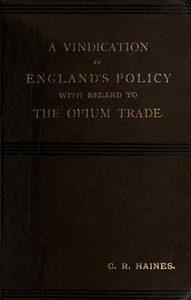
A Vindication of England's Policy with Regard to the Opium Trade by Haines
Let's be clear from the start: this isn't a novel. There are no characters to follow, no plot twists in the traditional sense. Instead, the 'story' here is an argument. Published in 1894, over fifty years after the First Opium War, Charles Reginald Haines sets out to do exactly what the title promises—vindicate British policy.
The Story
Haines builds his case like a prosecutor, but for the defense. He frames the opium trade not as a moral failing, but as a complex issue of commerce, sovereignty, and clashing civilizations. He argues that China's attempt to ban the trade was less about public health and more about maintaining a closed, superior stance against foreign 'barbarians.' From his perspective, British merchants were simply fulfilling a market demand, and Chinese officials were corrupt and ineffective in their enforcement. The wars that followed, in his telling, were about forcing China to honor free trade principles and diplomatic equality, with opium as the unfortunate spark. The entire book is a point-by-point rebuttal of the critics, using official documents, trade data, and contemporary accounts to paint British actions as logical, even necessary.
Why You Should Read It
You should read this not to agree with it, but to understand a powerful perspective often left out of modern summaries. It's a primary source document in the truest sense—a window into the mind of a late-Victorian imperialist. Reading Haines's confident, legalistic prose is a stark reminder that history is rarely a simple tale of good vs. evil. The most insightful parts are where his biases shine through clearest: his views on 'Oriental' governments, his absolute faith in free trade, and his belief in Britain's civilizing role. It challenges you to see a world-changing conflict through the eyes of someone who genuinely believed his side was justified.
Final Verdict
This book is perfect for history buffs and students who want to move beyond textbook summaries and grapple with the messy, contested narratives of the past. It's also great for anyone interested in the psychology of justification and how nations defend controversial policies. If you're looking for a thrilling narrative or a moral condemnation, look elsewhere. But if you want a raw, unfiltered example of 19th-century imperial rhetoric—the kind of thinking that built and justified empires—this is a compelling and sobering read. Pair it with a modern history of the Opium Wars for the full, jarring effect.
Elijah Sanchez
1 year agoAs someone who reads a lot, the clarity of the writing makes this accessible. This story will stay with me.
Mason Lopez
8 months agoSimply put, it creates a vivid world that you simply do not want to leave. Truly inspiring.
Michelle Lewis
1 year agoFrom the very first page, the atmosphere created is totally immersive. I will read more from this author.


Paul Gonzalez
9 months agoBased on the summary, I decided to read it and it challenges the reader's perspective in an intellectual way. Don't hesitate to start reading.