
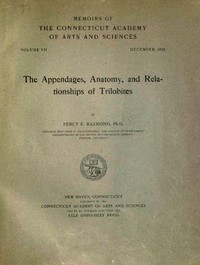
The Appendages, Anatomy, and Relationships of Trilobites by Percy E. Raymond
Let's be clear from the start: this isn't a novel. 'The Appendages, Anatomy, and Relationships of Trilobites' is a specialized scientific monograph from 1920. There's no plot in the traditional sense, but there is a brilliant and driven narrative of discovery. Percy Raymond, a curator at Harvard's Museum of Comparative Zoology, takes center stage. He's gathered all the known fossil evidence—some spectacular finds showing soft tissue impressions—and is methodically building a case. The 'story' is his meticulous process of observation, comparison, and deduction. He examines fossils under microscopes, debates the work of other scientists, and slowly assembles a complete picture of a trilobite from the inside out. He figures out how many legs they had, where their gills were, and how their mouths worked. The climax isn't a battle; it's the moment all these separate clues click into a coherent vision of a living, breathing animal.
Why You Should Read It
You should read it for the sheer thrill of the puzzle. Raymond's passion is contagious. You feel his excitement when he describes a fossil that perfectly shows a delicate leg joint, or his frustration when the evidence is unclear. This book reminds you that science is a human endeavor, full of arguments, dead ends, and brilliant leaps. It's about looking at a static, stone shell and seeing movement, biology, and ecology. Raymond isn't just cataloging dead things; he's resurrecting an entire extinct way of life. For me, the most powerful part is realizing how much we can learn from patience and careful looking. He had no CT scanners or DNA sequencers—just sharp eyes, a sharp mind, and a deep curiosity.
Final Verdict
This is a niche book, but its appeal is wider than you might think. It's perfect for amateur fossil hunters, biology students, or anyone fascinated by deep time and evolution. If you love true detective stories or shows that reconstruct ancient creatures, you'll find the same core satisfaction here. It's not a casual beach read; it demands your attention. But if you give it that attention, you'll be rewarded with a front-row seat to a foundational moment in paleontology, guided by one of its most dedicated detectives. Think of it as the original blueprint for how we understand life that vanished long before we arrived.
Jackson Perez
7 months agoHigh quality edition, very readable.
Ethan Sanchez
1 year agoGreat reference material for my coursework.
John Martin
1 year agoComprehensive and well-researched.
Lucas Robinson
2 months agoTo be perfectly clear, the depth of research presented here is truly commendable. I will read more from this author.




George Williams
3 months agoFast paced, good book.